Humans have been experimenting with government. It starts with the dawn of civilization. Organized government is one of the elements historians expect to find in a civilization. Each civilization is unique. Trying different approaches to government is part of developing a civilization. At different times in a civilization, there may be different varieties of government
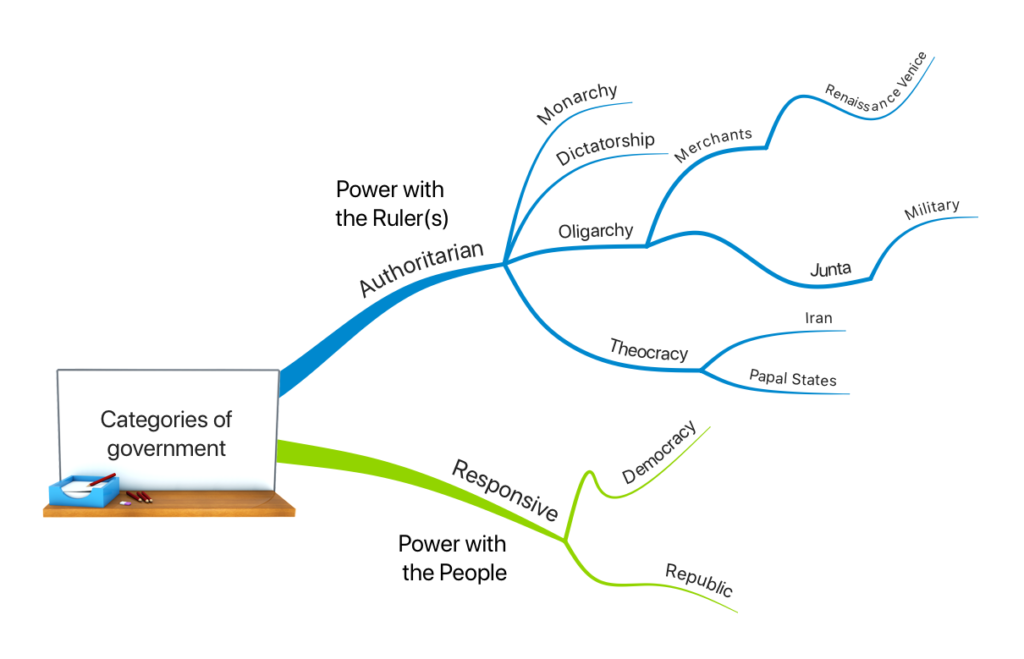
It’s possible to sort governments into categories. The sorting focuses on how a government operates. Two major categories are authoritarian governments and responsive governments.
Authoritarian governments are where all the power and all the decision making rests with one person or one small group of people.
Responsive governments are governments where power rests with the people and decision making responds to the will of the people.
Authoritarian governments
In a monarchy, ruling becomes the family business.
Monarchy
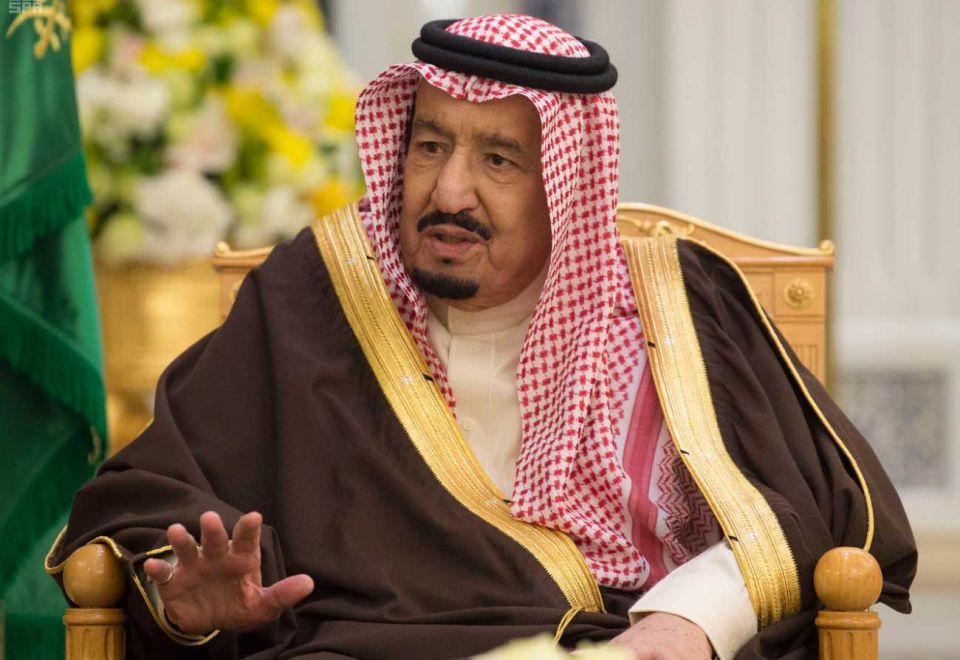
Monarchy is perhaps the oldest form of authoritarian government. One man becomes king/emperor and rules the kingdom/empire. The next monarch is a member of the dead king’s/emperor’s family. When the position of monarch is kept in the family it’s called a hereditary monarchy.
In some forms of monarchy, the position of monarch goes to the oldest male in the family. Thus, a dead king’s brother can become the next king. In some monarchies the living king picks the next monarch from among his sons. This is the practice of the Saudi monarchy. The living king chooses his crown prince, the man who will succeed him. Ottoman Sultans selected which of their sons would become the next sultan. So did Chinese emperor’s.
In Western Europe, the next king/emperor is usually the oldest son of the living monarch. This is called the rule of primogeniture.
However, some monarchs are chosen/elected. In Poland, the aristocracy choses each king. The emperor of the Holy Roman Empire is elected by the German elector-princes.
Dictators have proved to be some of the most blood thirsty, ruthless rulers in history.
Dictatorship
A dictator is a single person who seizes power and rules as s/he see fit. Generally, no one tells them what to do. They tell everyone else what to do.
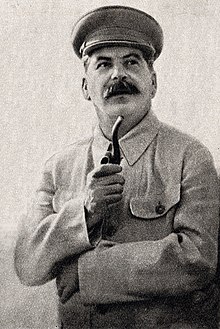
Joseph Stalin of the Soviet Union (Russia), is perhaps the most successful dictator in history. Everyone, including a dictator, needs underlings. People under him who are loyal and will carry out his directives. But just how far can you trust your underlings? Stalin trusted NO one. He used underlings for a while, then had them executed. This way, he believed, underlings didn’t have the time to successfully plot against him.
Mao in China and Pol Pot in Cambodia ruled as communist dictator in the same way as Stalin.
During the Third Reich (1933 – 1945) in Germany, Hitler was a dictator. From 1922 to 1945, Mussolini was the dictator of Italy. Between 1919 and 1945, many European countries become dictatorships. Pilsudski is the dictator of Poland. King Carol II becomes a royal dictator of Roumania.
During the 20th Century, many Latin American countries are ruled by dictators. Juan Paron of Argintenia is a famous Latin American dictator as is Fidel Castro of Cuba. Today, Assad in Syri is a dictator.
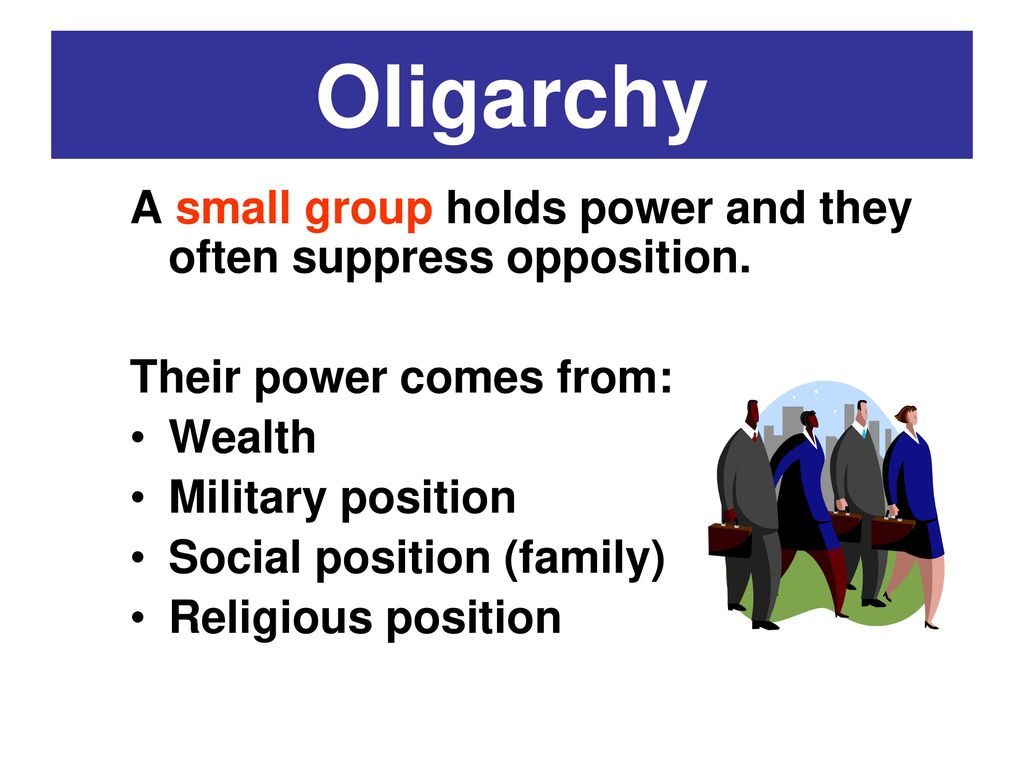
A group can take all the power for itself and become the final collective decision maker.
Oligarchy
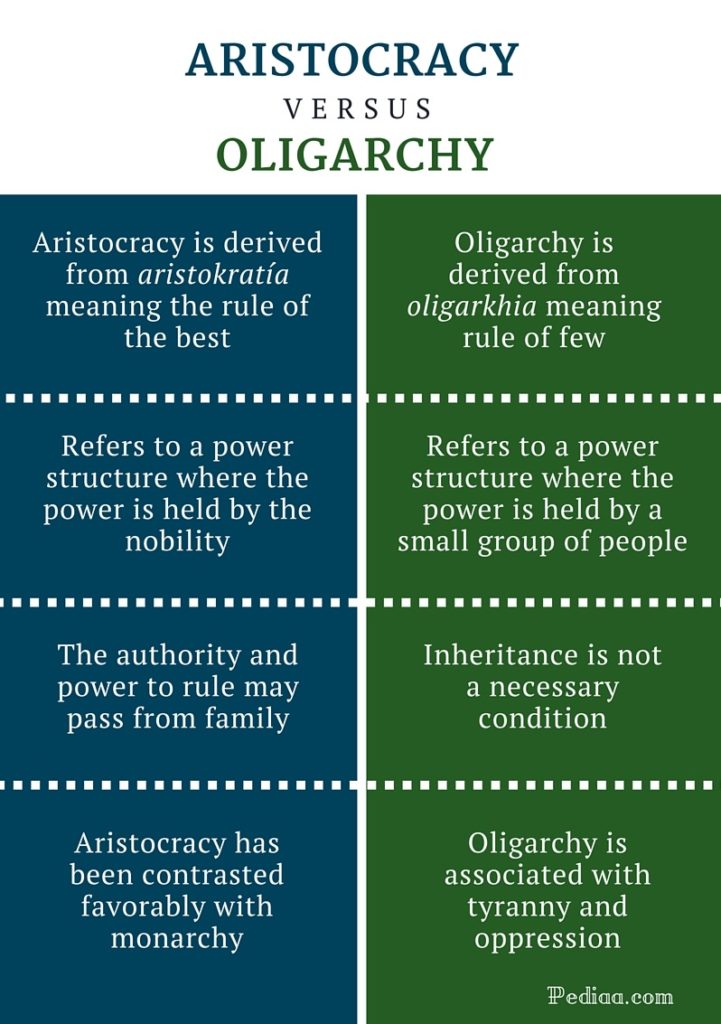
If, the country is ruled by a small group po people, it’s an oligarchy. Oligarchies are group dictatorships. Because there is a group making the decisions, it’s usually less blood thirsty and vicious than a dictatorship. But oligarchies can be brutal.
The Renaissance Republic of Venice is an oligarchy. The top level decision makers are a group made up of the most important members of each of the powerful trading families in Venice. This council rules Venice. It choses one of its members to run Venice day-to-day. He’s called the Doge.
Deng Xiaoping converted government in communist China into an oligarchy. It’s ruled by the collective senior Communist Party leaders. (Today, President Xi Jinping is trying to change it back to a personal dictatorship with himself in charge.)
What happens when the military becomes involved in government?

Junta
A junta is a small group of military offices who govern a country. Today Burma is ruled by a group of senior army officers, a military junta.
A junta is the result of the military seizing power. High level officers in the military use its soldiers, tanks and planes to take control of the government. This power grab is called a coup d’état. The regular government and the rules of government are ended. The senior military officers as a group rule with dictatorial powers.
Thus, a junta is a military oligarchy.
In a theocracy, god rules through the identified religious leader/leaders.
Theocracy
Religious leaders have influence over the faithful. In ancient societies, priests of temples coul tax the public to operate the temple. They could control some parts of daily life.
Religious leaders have argued that the ruler should be god or the gods. A priest or priest become his agents they rule in his name according to the god’s dictates.
Rule by religious leaders is called a theocracy.
During the Renaissance, the Pope rules central Italy, the collection of regions then called the Papal States. For instance, Pope Alexander VI rules the Papal States as an absolute ruler who is the vicar of Christ.
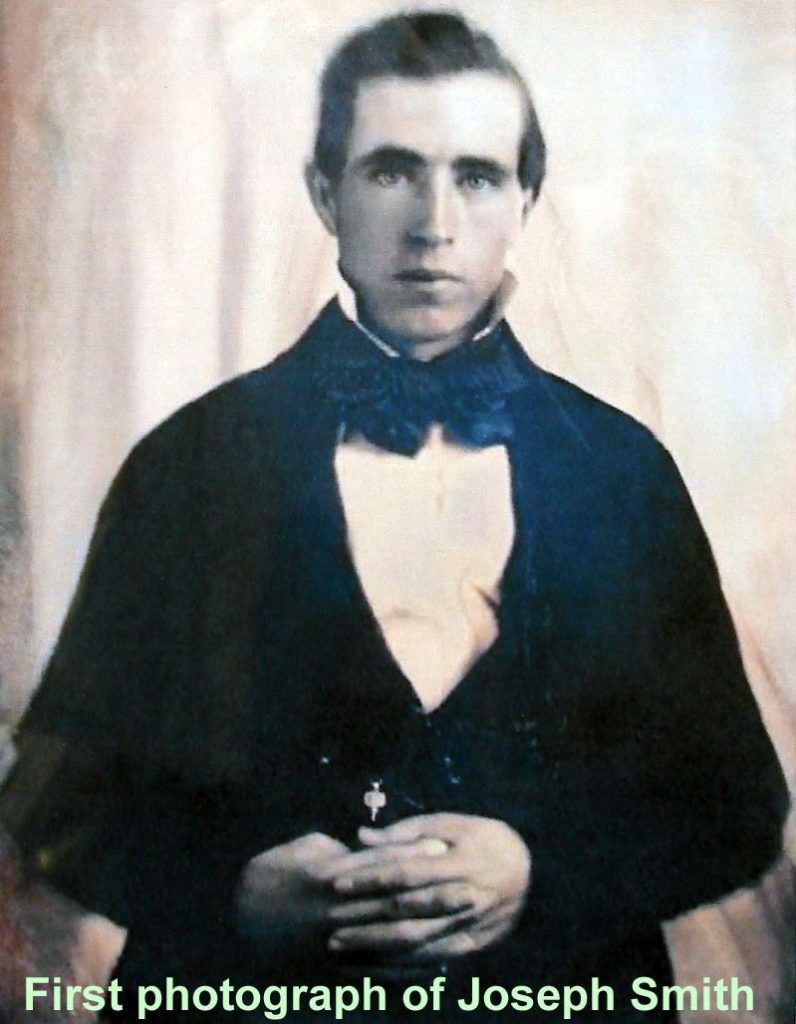
The Mormon community at Nauvoo, Illinois and Salt Lake City, Utah sought to create a theocracy. The Phophet of the Church of Jesus Christ of the Latter Day Saints, first Joseph Smith and then Brigham Young, are the rulers. The 1857-1858 Mormon War saw the U.S. Army battle the Mormon settlers in Utah to put an end to the Mormon theocracy in Utah Territory.
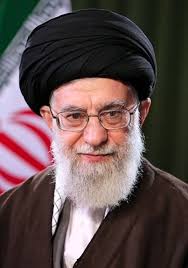
Today, Iran is ruled by a Supreme Leader. He’s the most senior Islamic religious leader within Iran. Iran is an Islamic theocracy.
Responsive government
Democracy
In the West, democracy is said to,have started in Ancient Athens. In Ancient Athens, every citizen of the city state had a vote on every issue of government. Citizens elect the officials. Citizens select the generals to carry out military campaigns. Citizens vote on every law, on declarations of war, and on treaties. They vote in the taxes. They also vote as a jury at trials.
In a direct democracy, the citizens have a vote on everything their government does.
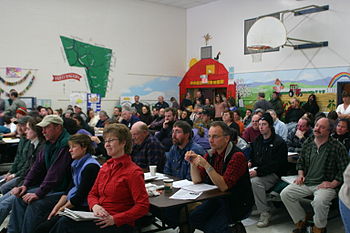
This type of direct democracy was used and still is used in New England villages and small towns. All the citizens gather at a town meeting and vote on all of the village’s business. They elect selectmen to handle the administration of their decisions.


Republic
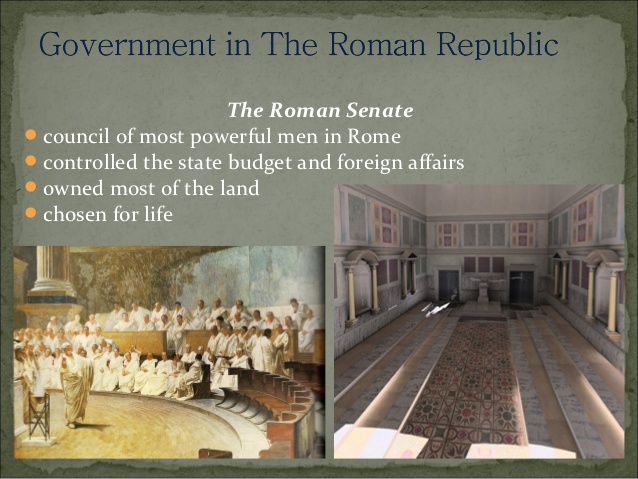
In a republic, citizens vote to chose representatives. These representatives are the people who vote on government decisions. They form a group of lawmakers. It might be called a Legislative Assembly, a Parliament, or a Congress. This group of lawmakers creates the nation’s laws and sets taxes.
The current governments of the 50 states and of the United States are republics. So is France, Canada, the Czech state, along with many other countries in Western Europe and South America.
The republic is the most common and most effective form of government that’s responsive to the will of the people. The idea of “liberal democracy” is tied to the structure of the republic in the West.
See a list of nations and their type of government